Skip to content
KIN

KIN

Know what the research says.

KIN makes credible research about Black America easier to find, understand, and use.

Where knowledge meets connection.

Ask KIN

What do you want to understand?

Why are Black women experiencing higher maternal mortality rates?

Sources searched

Scholarly journals & repositories

Evidence strength

Shown with every answer

Citations

Always visible

Illustration of the KIN question interface. Example questions include: Why are Black women experiencing higher maternal mortality rates? What does research say about Black boys and school discipline? Does attending an HBCU affect career outcomes? What does research say about Black homeownership and wealth?

The problem

The research exists. Finding it is the problem.

Research about Black health, education, justice, wealth, work, family, and culture is scattered across academic journals, databases, institutions, and disciplines.

Finding the right research often means knowing

  1. i.where to search
  2. ii.what terminology to use
  3. iii.how to interpret academic language
  4. iv.how to evaluate what is actually relevant

Access to information is not the same as access to understanding.

How KIN works

Ask a question. Follow the evidence.

The full process
  1. 1

    Ask

    Type a real question in plain language.

  2. 2

    Find

    KIN searches trusted scholarly sources.

  3. 3

    Prioritize

    KIN surfaces research meaningfully connected to the population and question.

  4. 4

    Understand

    Get a clear explanation of what the research says.

  5. 5

    Go deeper

    Explore the studies, methodology, limitations, and citations yourself.

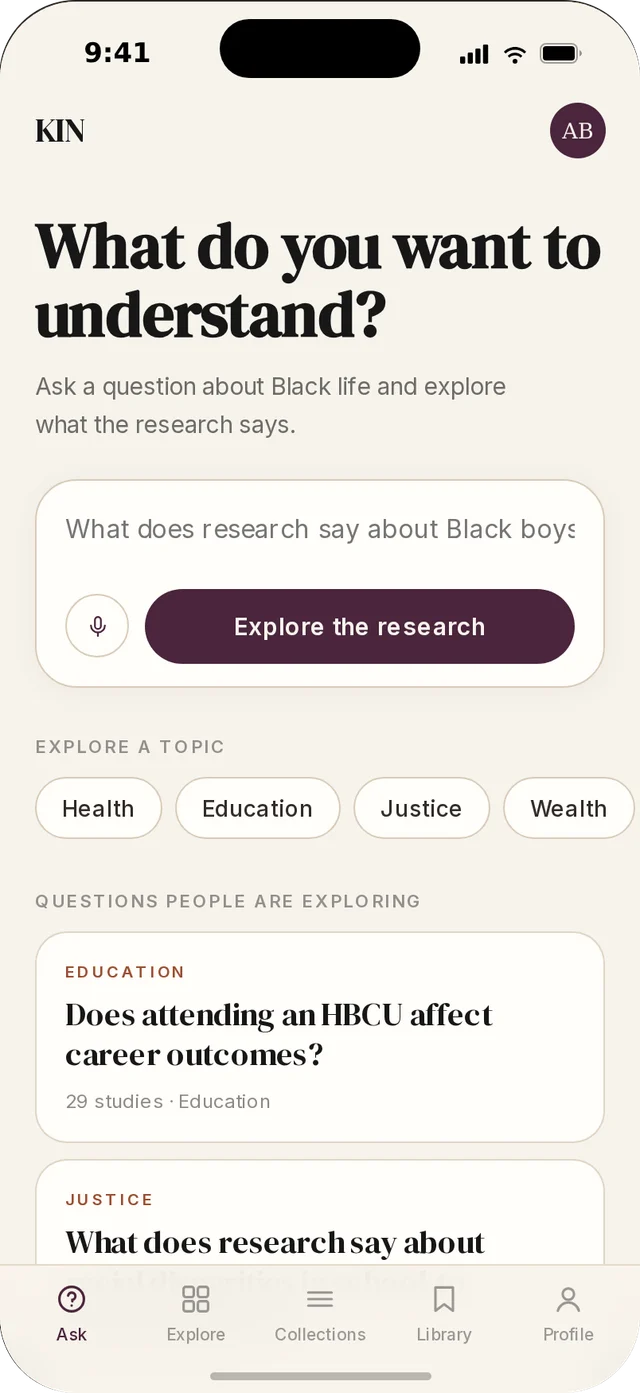
  1. KIN app screen asking “What do you want to understand?”, with a question box, topic chips, and questions people are exploring.

    Ask

    Start with a real question, in your own words.

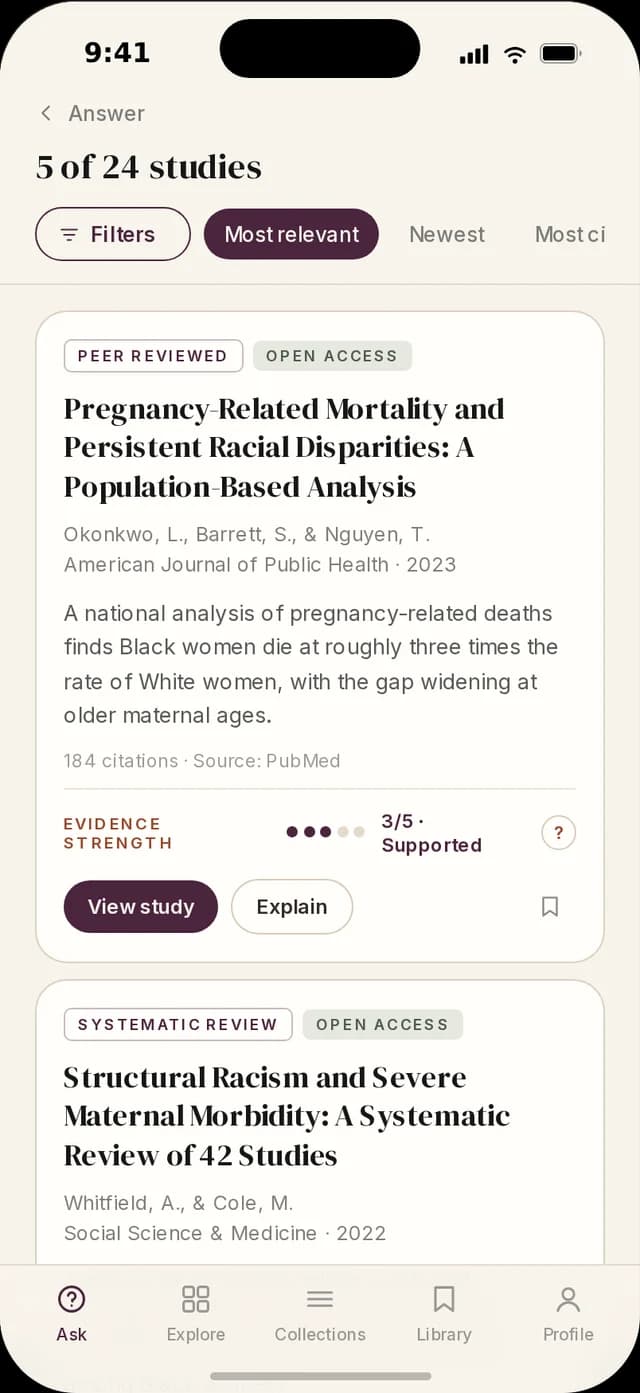
  2. KIN app evidence list showing 5 of 24 studies, each with source type, open access label, evidence strength, and View study and Explain buttons.

    Find & prioritize

    See the studies behind the answer, most relevant first.

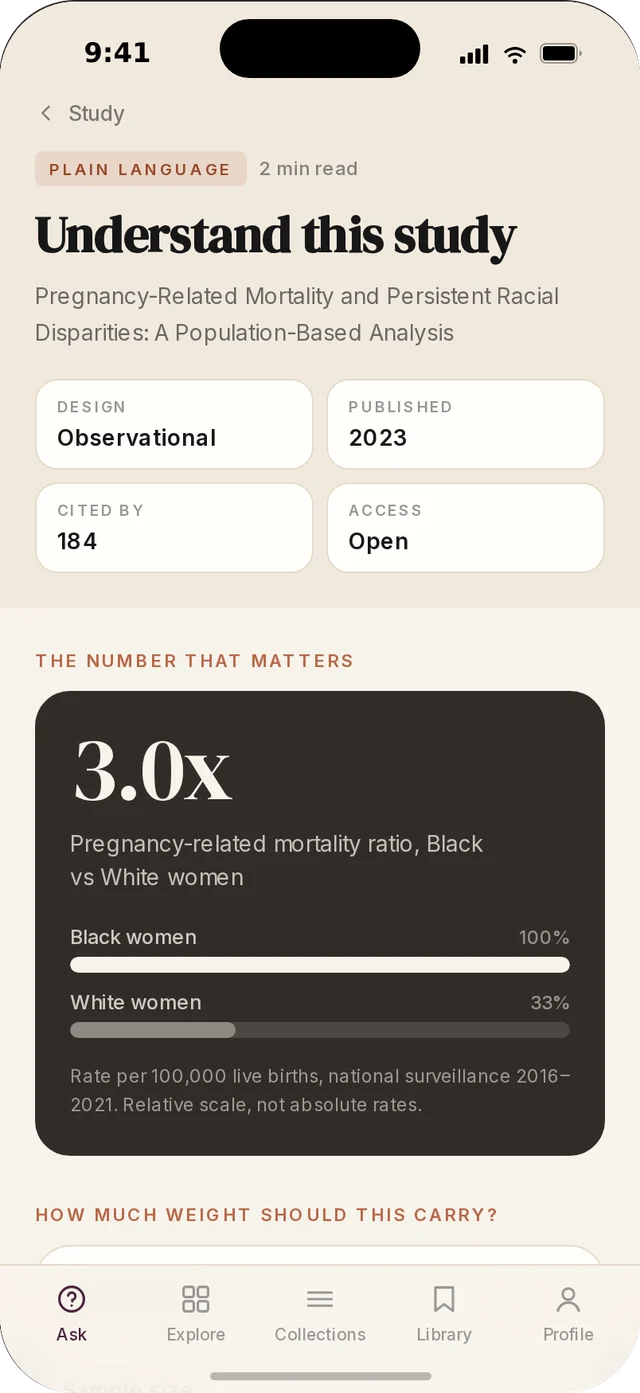
  3. KIN app “Understand this study” screen with study design, year, citations, access, and the number that matters: a 3.0× mortality ratio.

    Go deeper

    Open any study to see its design, numbers, and limits.

Screens from the KIN prototype. Studies shown are demo data.

The experience

A clear answer, with the evidence attached.

Every answer shows how strong the evidence is, how much research stands behind it, and the studies it came from.
Illustrative demo contentSample answer · Not real research

Your question

Why are Black women experiencing higher maternal mortality rates?

The short answer

Research points to a combination of factors — differences in the quality of care, chronic health conditions, and structural barriers — rather than any single cause.1,2

What the research shows

  1. 01

    Disparities persist across income and education levels, suggesting socioeconomic status alone does not explain the gap.1

  2. 02

    Where people deliver matters: differences in hospital quality are associated with differences in outcomes.2

  3. 03

    A large share of pregnancy-related deaths are considered preventable, pointing to gaps in care before, during, and after birth.3

Evidence strength
Strong
Based on
24 relevant studies

Explore the evidence

3 of 24
Peer-reviewed studyOpen access

Demo study: Delivery-hospital quality and severe maternal outcomes among Black patients

Sample Journal of Maternal Health · 2023

94%Match Score
Systematic reviewPublisher access

Demo review: Structural and clinical factors in pregnancy-related mortality

Example Review of Public Health · 2022

91%Match Score
Qualitative studyOpen access

Demo study: Patient-reported experiences of care during pregnancy and postpartum

Illustrative Journal of Health Equity · 2024

87%Match Score

KIN Relevance

Mention is not the same as relevance.

A study can include Black participants without actually telling us anything meaningful about Black outcomes.

KIN Relevance is designed to look beyond simple keyword matches and help identify research where Black populations are meaningfully connected to the study population, analysis, findings, and question.

Sample Match Score

Match Score measures relevance to the question, not overall research quality.

  1. 01

    Population relevance

    Are Black populations central to the study?

  2. 02

    Topic alignment

    Does the study actually address the question being asked?

  3. 03

    Analytic relevance

    Are Black-specific outcomes meaningfully analyzed?

  4. 04

    Findings relevance

    Does the research produce findings that directly inform the question?

  5. 05

    Contextual relevance

    Do geography, age, gender, setting, or timeframe affect applicability?

  6. 06

    Evidence usability

    Is the research record complete enough to support useful interpretation?

Trust & transparency

You should be able to see where the answer came from.

KIN is designed so users can follow the evidence themselves.
Transparent citations
Claims connect back to identifiable sources.
Research context
See the study population, methodology, and limitations.
Evidence strength
Understand where findings are strong, mixed, emerging, or limited.
Original sources
Follow links to available full text, publisher pages, or research repositories.

You do not have to trust the AI. You can inspect the evidence.

Research areas

Built across the questions that shape Black life.

  • Health

    Maternal health · Mental health · Chronic disease

  • Education

    HBCUs · School discipline · Student outcomes

  • Justice

    Policing · Incarceration · Sentencing

  • Wealth

    Homeownership · Intergenerational wealth · Lending

  • Family & Community

    Caregiving · Neighborhoods · Faith institutions

  • Work & Opportunity

    Employment · Entrepreneurship · Wage gaps

  • Culture & Society

    Media · Identity · Civic life

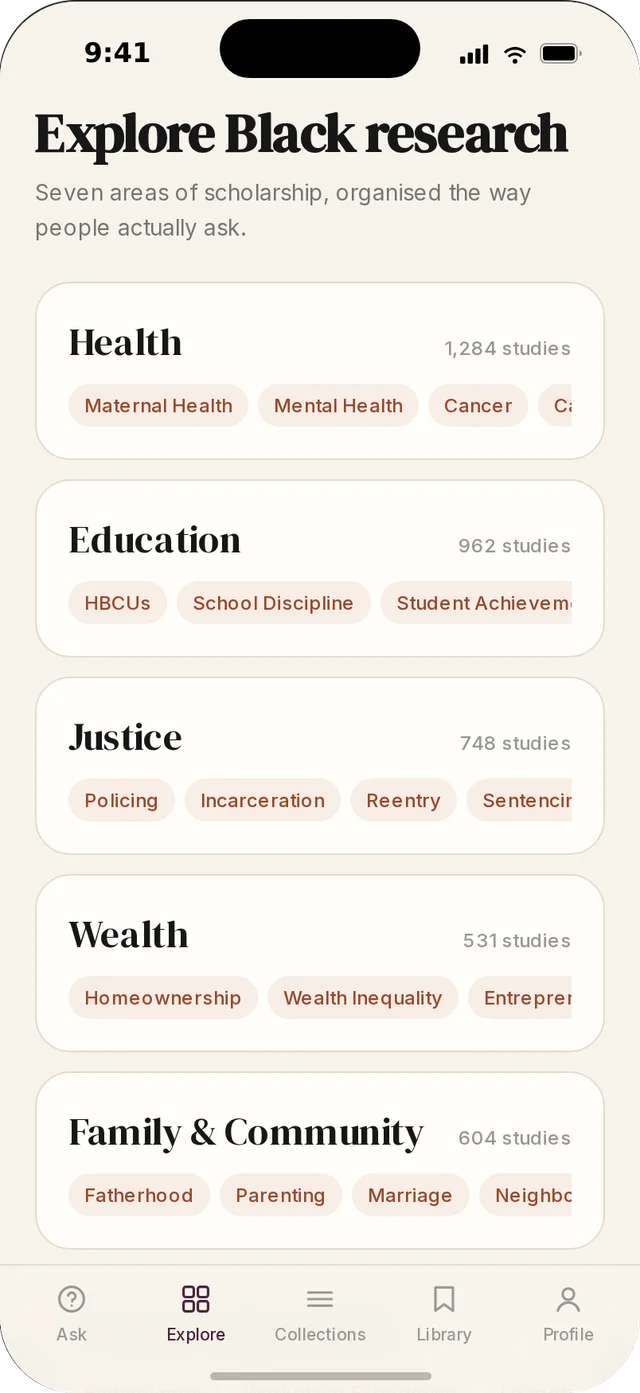
KIN app Explore screen listing research areas — Health, Education, Justice, Wealth, Family & Community — with study counts and subtopics.

Screens from the KIN prototype. Studies shown are demo data.

Who KIN is for

Research should move beyond the journal.

KIN is designed for people who need credible information but may not live inside academic databases every day.
  • Students
  • Researchers
  • Educators
  • Journalists
  • Community organizations
  • Healthcare professionals
  • Policy teams
  • Industry
  • Families and curious individuals

KIN Campus

Bring KIN to your campus.

KIN Campus is being designed for universities, HBCUs, libraries, public-health programs, and Black Studies departments.

  • Campus-wide access
  • Faculty-curated collections
  • Research literacy tools
  • Shared academic collections
  • Institutional usage insights
  • Library integrations
  • SSO
  • Research alerts

KIN Teams

Turn research into shared intelligence.

KIN Teams is being designed for organizations that need to understand and use research quickly.

Nonprofits · Foundations · Healthcare organizations · Life sciences · Agencies · Research teams · Journalists · Government

  • Shared research workspaces
  • Evidence briefs
  • Team collections
  • Collaborative synthesis
  • Research monitoring
  • Advanced exports

Why KIN

Knowledge becomes more powerful when more people can use it.

For generations, Black communities have shared knowledge through families, schools, churches, HBCUs, newspapers, community organizations, and everyday conversation.

KIN is built on that same principle:

knowledge should move.

Research reaches its highest value when it is understood, exchanged, challenged, and put to work.

About the name

Why KIN?

KIN is about connection. It reflects the idea that knowledge is rarely useful in isolation.

What one person learns can become valuable to a student, a family, a researcher, a community, or an institution.

KINnoun
The platform.
KINfolknoun
The community around it: the people who ask questions, share knowledge, challenge assumptions, and help research move farther.
More about KIN

Early access

Help shape what KIN becomes.

We are building KIN with researchers, students, educators, community leaders, and early users who believe credible research should be easier to access and understand.